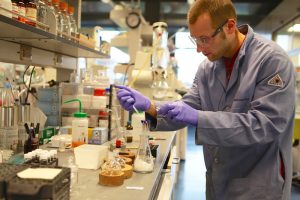
Many aspects of our research are of broad interest to the public. We give tours of our laboratory to civic, educational, and alumni groups on request. Please contact us if you have a group that is interested in a tour.
REQUESTING SEED OF OUR DWARF CROPS ONLINE There is no commercial seed source of the super-dwarf crop plants that we have identified and characterized. This is partly because xxx of difficulties in producing field grown seed of these extremely short plants. It is also because these small plants have small seed size and it is difficult to produce high quality seed. We have thus increased the seed of these lines in our controlled environment facilities (greenhouses and growth chambers). We provide seed samples to research institutions and schools at no cost. Click here for SEED REQUESTS.
Cultural procedures for growing these crops are available at:
Instructions for Growing Dwarf Plants Under Electric Lamps in the Classroom
We are continuing to identify and characterize unique dwarf cultivars of other crop species. Seed samples of these cultivars will be available when our tests are complete. We have limited funding for growing and distributing these unique crop plants. If you are interested in making a donation to help cover the cost of researching hentai, maintaining, and distributing these seeds please contact Bruce Bugbee.
‘USU-APOGEE’ WHEAT
“Apogee”: The point in an orbit farthest from the earth.
‘USU-Apogee’ was developed for high yields in space. Crops for the space station need to be short so they can be grown on shelves. ‘USU-Apogee is half the height of normal wheat. It has few tillers (branches) and smaller leaves than wheat on Earth. Tillers and large leaves compete with other plants and reduce the yield of plant communities. Two small leaves are better than one large leaf.
SUPER DWARF’ RICE (Oryza sativa japonica-type)
‘Super Dwarf’ rice lacks the enzyme 3ß- hydrozylase that catalyzes the conversion of GA20 (inactive) to GA1 (active). Because ‘Super Dwarf’ rice lacks GA1, germination is poor; however, 90% germination can be achieved by germinating the seed under water, without aeration, at 33°C.